Friday, April 12, 2024

Mauritius

The change of cruise itinerary meant a visit to Mauritius. This is a tiny island off the East coast of Africa (Madagascar). At about 50 kms wide and 60 kms long it is not a large island but does accommodate a population of about 1.2M. It is an interesting mix given the last ‘protectors’ were British, driving on the left (incidentally this has been the case with all shore locations so far on this trip) and English road signs. However, none of this has impacted the main language which stubbornly has remained French!

We partcipated in a small bus Cunard tour. Our first stop was to the North of the island at Notre-Dame Auxiliatrice de Cap Malheureux. It has a simple but attractive standalone bell tower.

The location can only be described as idyllic. Beautiful beaches, shady trees, gently rocking boats and industry that melds with its surroundings. A warm day suggests standing in the sea is a good idea to keep cool while filleting fish. It also ensures any waste product returns to its origins. 

The beautiful location belies a bloody history. Just offshore is Coin de Mire Island. This is where, back in 1810, the British launched an attack on French held Mauritius to support its desire to control trade between Europe/the Cape and India/the Far East.

That said whatever the viewpoint it is still hard to get past this being a mesmerically beautiful location. Let’s hope it survives increasing sea levels.

Our second stop was a sugar mill. Although machinery was initially imported, any repairs had to be on site. Broken castings had to be rebuilt using a mould, sand impression and casting processes. Local resources needed to be skilled in manufacturing as well as operations because waiting for a shipment from England was not a viable option.

The machinery to crush the sugar cane was huge.

There were three similar bays to ensure as much of the sugar was extracted as possible. (Helen helps to give this some scale.)

The museum was huge and the half hour we were allocated was not nearly enough. The result is that we missed our free rum sample!

We then moved onto the 37-hectare Sir Seewoosagur Ramgoolam botanical gardens. The colonial house melds well into the gardens.

What was noticeable as soon as we walked into the gardens was the wonderful bird song. That said spotting the birds amongst all the foliage was quite a challenge. This Red Fody at least made visibility a little easier with its wonderful red colour.

The range of trees and other plants is huge so I will focus on just two. This Tall Pot palm tree is unusual as it flowers once in about 40 years and then dies. This one is now due to be felled and replaced.

However, the real draw card were the giant water lilies which originate from the Amazon basin in Brazil. The leaves can grow up to 3 metres and the vertical rims are very unusual.


The leaves have spines on their underside as a defensive mechanism against predators.

As for the flowers they are short lived. Initially white they turn violet on day two and then on day three sink to develop into a seed capsule with some 500 seeds. Most of the blooming takes place at night!

On the way out these lotus flowers popped up just above their leaves and almost demanded to be photographed. 

Mauritius in short is a beautiful island where our short trip to the NW corner was very enjoyable although I do feel we have barely scratched the surface.

Sunday, April 7, 2024

Colombo

Out last trip to Colombo was quite a few decades ago. Suffice to say Michael was in cloth nappies (there were no disposable ones) and Lianne still had a few months to go before entering this world. The interim has seen a few changes! Previously the only way to travel was in a Morris 1000 as it was the only vehicle on the road. Notwithstanding some had mileages upwards of 500,000 they were all impeccably kept. This trip we did not see one Morris car and travelled in a 9 seater air conditioned ‘van.

Our first trip was to the Kelaniya Raja Maha Vihara temple where (after shoes off) our guide went and got us some flowers so we we could dedicate them to Buddah.

Dianne ensured hers were in a prime location (amongst all the others!)

The main temple and stupa are a real contrast both in shape and colour. 

Inside we were greeted by a reclining Buddha protected from the hoards by a thin curtain.

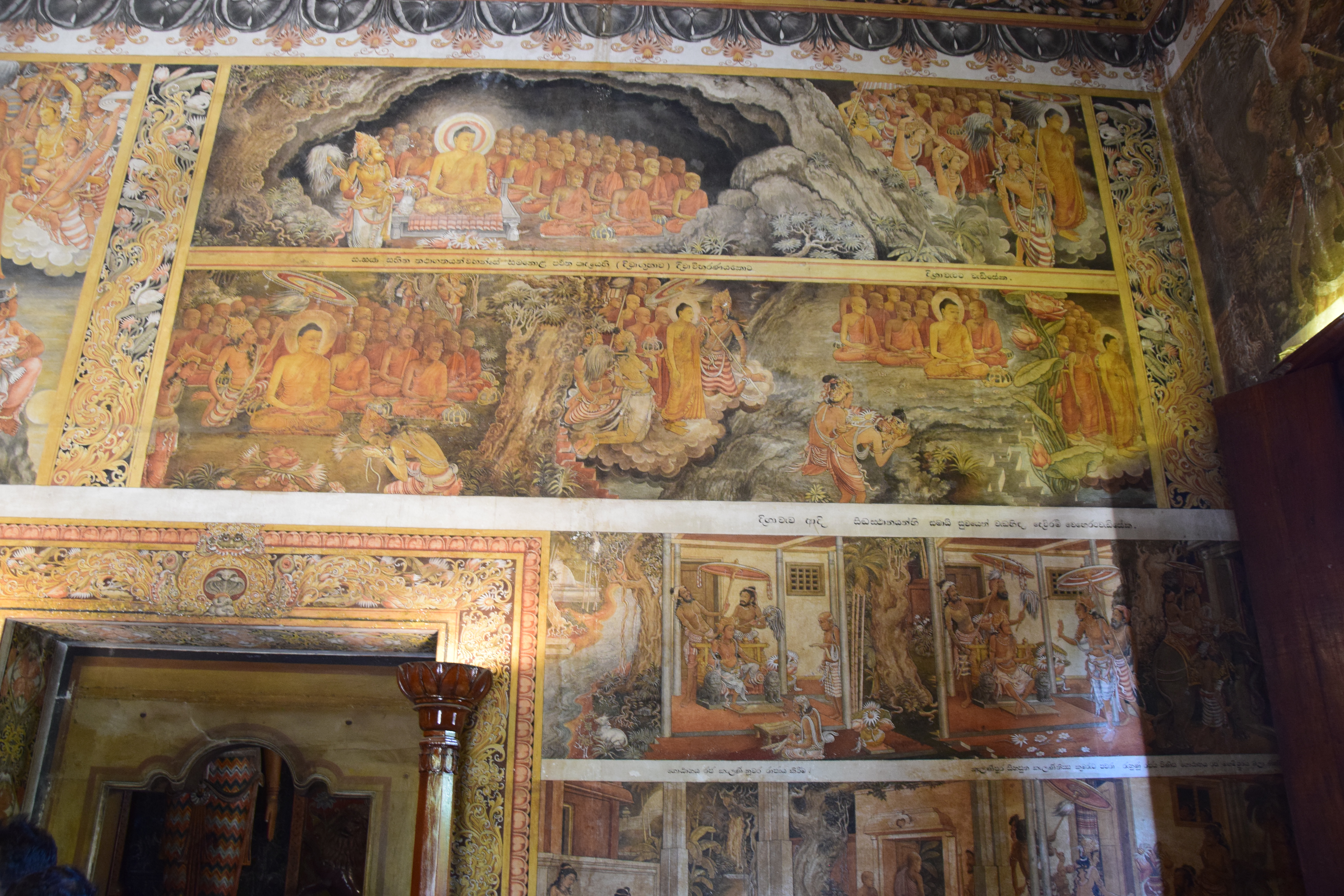
Whilst further inside the walls and ceilings we covered in detailed stories of Buddha’s travels and adventures.

The Stupa was not accessible but also cut a sharp contrast with the blue sky.

This is a very popular temple as the racks for making an offering attest.

As we travelled through the city centre (which was vey busy despite being a ‘quiet Sunday’) we entered the markets in the middle of which was the ‘red mosque’. It is striking and apparently much larger than the narrow street frontage would suggest with a capacity of some 20,000. 

We then made our way to the lotus tower – a tourist attraction paid for by the Chinese. Its claim to fame (being 356 metres high) is that it is South East Asia’s tallest tower. (It seems to me if you narrow down the geography anything can be the tallest of somewhere….) The tower looks great at night as the ‘flower’ changes colour, however we were there for the view. 

We could see QM2 amongst the jumble of the port including the half constructed elevated by-pass highway. We also had a commanding view of the new ‘port city’.  Unfortunately, (as with the lotus tower) it appears Sri Lanka will default on the project loan payment due to the Chinese and end up handing both projects over to them. A cheap way of getting a major foothold into the country.

After all that activity the ‘Curry club’ was a welcome stop for lunch. This was previously the location of the Dutch hospital back in the 1730s (the precise date is unkown). The club had some great food, drink and air-conditioned comfort all of which were very appealing. It was a good job this was a private tour so we could take our time! 

The mobile chef was responsible for making ‘hoppers’ which from his flamboyancy was a role he clearly enjoyed. Hoppers were one of the few available no onion or garlic dishes that Alan could enjoy.

Our last temple (Vajiraramaya - more shoes off but smooth and welcome cool tiled floors) was largely built around a magnificent Banyan tree. Apart from branch supports the structure has over the years been adapted to accommodate some of the longest and largest branches I have ever seen.

It was also home to some very noisy parrots.

‘Out back of temple’ (Northern accent required) was a very bright silver monument suitably aligned to reflect the sun into our low-level observation point. With stepped buddhas in front it was not a combination I have previously encountered.  

As we returned to the port, we encountered the Independence Memorial Hall which was opened on the 4th February 1948. Since then, Sri Lanka has certainly had its ups and downs. The 10-year civil war with the Tamils, huge indebtedness to the Chinese and recent bankruptcy bail out by the World Bank have all ensured the country has remained much poorer than should be the case. It is to be hoped that the low point has been passed and from here on life starts to really look up for a country that from our first visit has some fantastic geographical attributes and wonderful people.


Phuket (Jame Bond Island)

Phuket is an island off Thailand where a trip to the (now) famous ‘James Bond Island’ (see the Man with the Golden Gun ) beckoned. We opted for a modern speed boat which held about 30 people. With three 250 HP engines on the back we were not going to hang about!

After an hour we got up close to our first outcrop. It is an extraordinary part of the world comprising limestone karst towers in a beautiful green sea. 250 million years ago (the Permian period) a barrier reef was disrupted through tectonic plate movement. The reef was breached and eroded in many areas while others survived. Now with lower sea levels the karsts are left high and dry. With caves, stalactites and tide related erosion, every corner held a surprise.

Some of the overhangs are huge. I assume some occassionally break off but hopefully not today!

In addition to the newer speedboats the standard Thai ‘long tails’ were in plentiful supply. Noisy and inefficient (given the amount of water they spray upwards) they are at least breezy!

As for James Bond island it can only be described as chaotic. Some 4000 visitors a day on a tiny island ensures that state.

It is a constant movement of boats coming in, dropping off passengers then heading out to sea and returning half an hour later to pick up (hopefully the same) passengers. Given there are some 6 ‘berths’ which are not only very tight but at different angles (up to 90 degrees) plus natural overhangs coupled with the noisy open engines of the long tails – well you get the picture - chaotic really doesn’t cut it!

Once on the island there are a couple of remarkable features. This cliff face has slipped in a perfect plane.

However, the main attraction is this famous karst tower.

Getting a shot without people in it was almost impossible so you will just need to imagine the beach where Bond (Roger Moore) had a dual and as they paced away from one another – vanished.

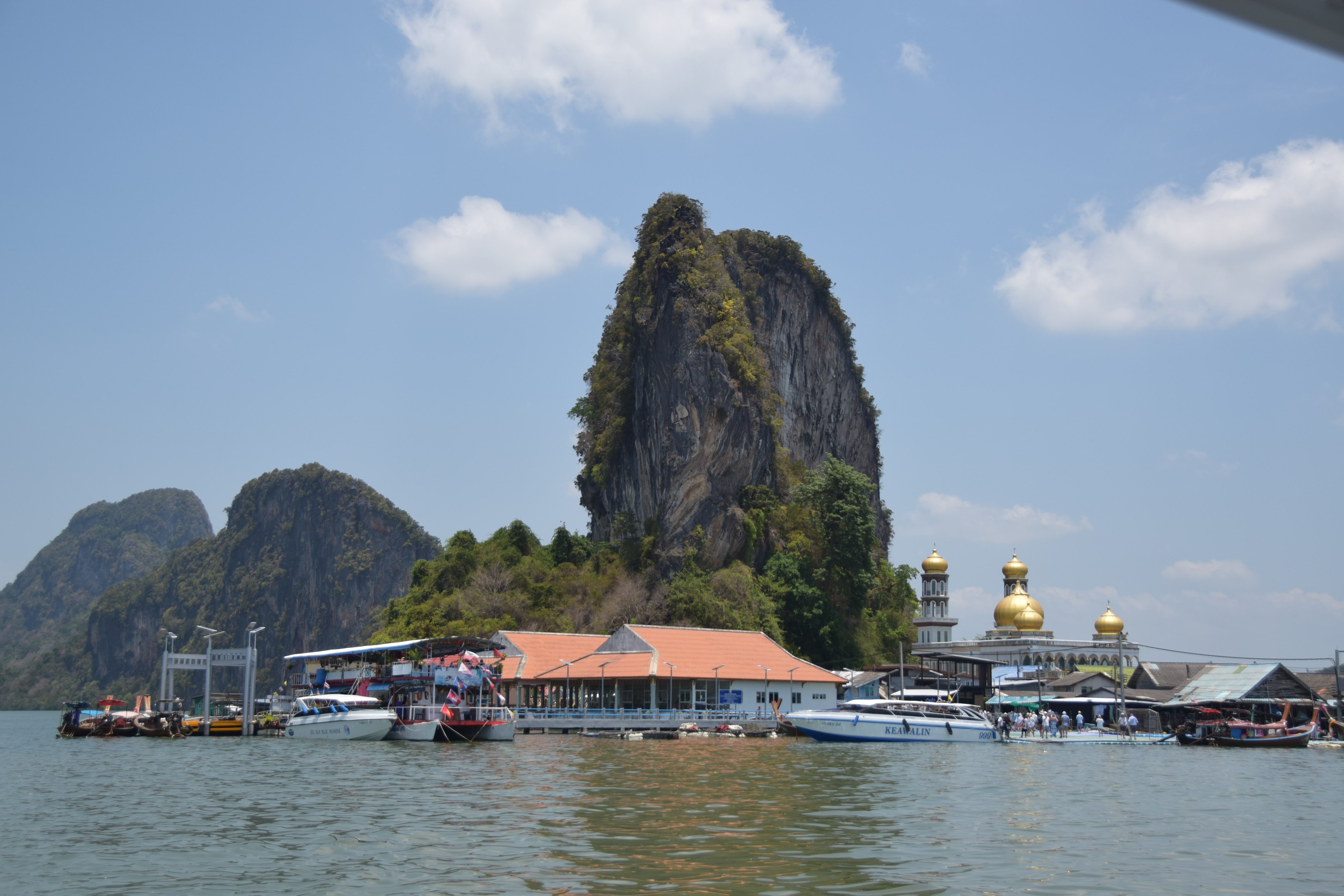
Once the obligatory picture had been taken it was back to queuing for our boat and another quick trip to a small (partially) floating town. This fishing village of 1500 people has a substantial mosque (thanks to Saudi), a school and even a soccer pitch.

What was also noticeable was that the large outdoor restaurants had food out but not a single fly. An unusual existence where you definitely need to love thy neighbour (or at least get on with them).

And with that we headed back to the mainland. This departing shot really sums up this extraordinary area. 

All the adventure meant we were late for a buffet lunch where all food types were available from a range of indoor stalls. It was tasty so we wanted to take our time. The guide assured us that taking our time was fine as this was a Cunard tour and the ship would wait for us! 


Wednesday, April 3, 2024

Langkawi - Malaysia

Langkawi (or rock eagle - our guide’s translation) is an island off the Malaysian coast which is geared to tourists. We had a private tour arranged aboard an air conditioned 7 seater - a much appreciated haven to revive between very hot and humid stops.  

Langkawi seems to be all about man made tourist attractions. The Maha ('the almighty') tower took 10 years to build and was opened in 2022. At 138 metres tall I am sure it has a good view from the top but we passed the opportunity by as we had higher trips planned for later in the day. 

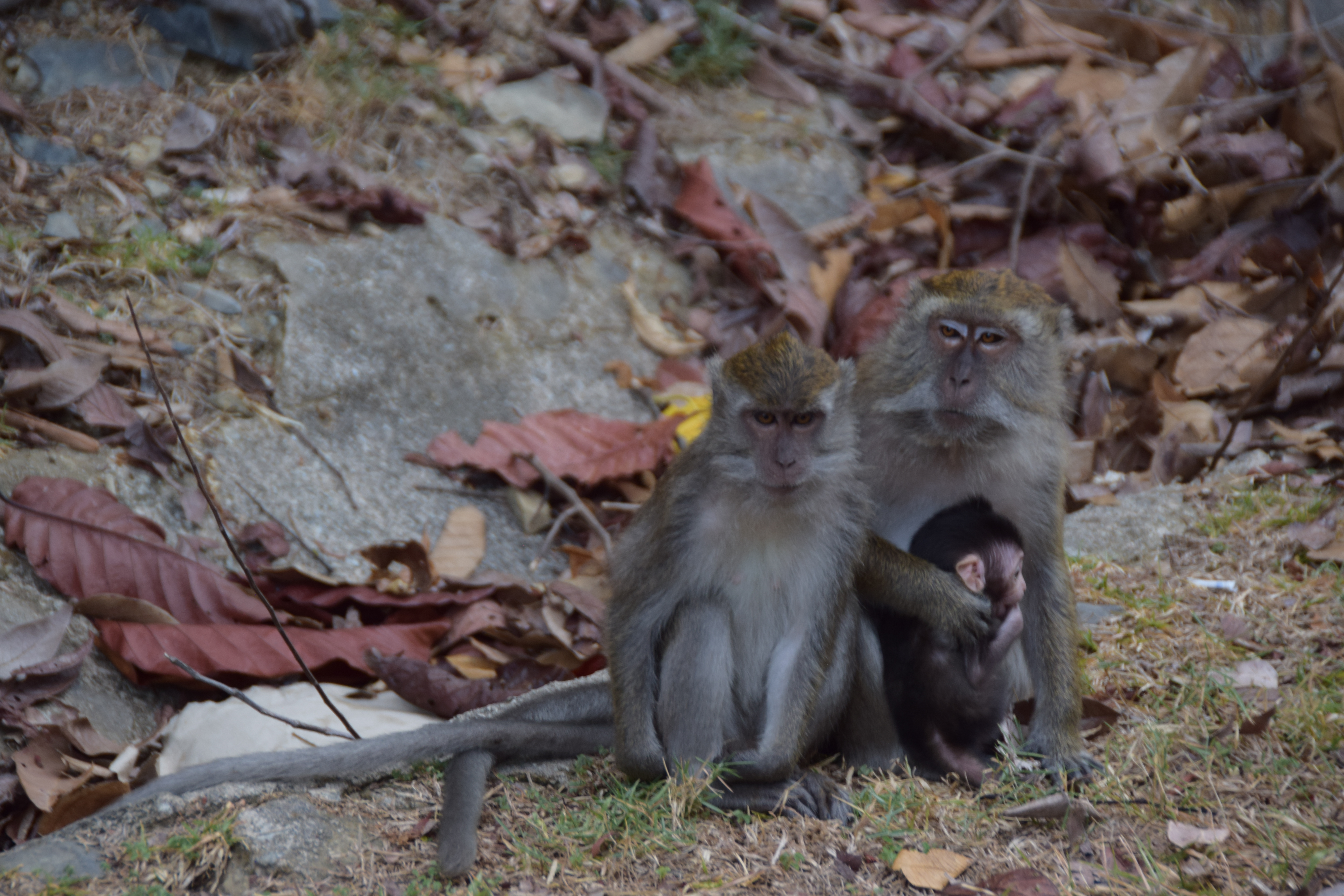
The crab-eating macaque (or long tailed macaque) flourishes in the area, as the numerous offspring we saw attests.

Our second point of call was a boat trip through the mangroves. The first highlight were white bellied eagles being tempted by a few chicken wings. They seem to be debating 'shall we compete?'

The brahimy kite or brown eagles by comparison were already up for the challenge.

and clearly found it worthwhile.


After a similar show feeding monkeys (peanuts rather than chicken wings) we ventured into more cavernous surrounds. All good provided the tide is low! We also hopped off for a quick interlude into a bat cave (no flash allowed....)

We had an enjoyable couple of hours on the water. Once back on shore we moved to the North West side of the island to take to the air. The ‘SkyCab’ is an extraordinary 2.2 kms long, 15 minute gondola ride. The longest free span is 950 metres which, at 42 degrees, is the steepest gondola in the world. At about 700 metres above sea level it is a similar altitude to Canberra (but a lot warmer!). 

Of course to get a good feel for the height you do need a glass bottomed gondola….

The cab has a midway station with attractions and ends up near the Sky Bridge. Unlike the gondolas which were German built this gravity defying piece of engineering was designed by Swiss engineers. The completed structure is awesome both aesthetically and engineering wise. 

How it was built is another question altogether. Most was apparently prefabricated and lifted in using a Russian Kamov twin rotor helicopter. However, that does not explain the sequence of erection which I suspect was from the middle outwards. In such an inhospitable piece of country it must have been a significant challenge.

The single pylon has 10 cables and the horizontal load from the curve of the bridge is balanced by the pylon’s lean towards the centre. At 125 metres it is the longest pedestrian curved bridge in the world. Quite a tourist attraction.

The bridge is at a slightly lower level (well some 300 steps) from the top of the cable car. Walk if you want or take the SkyGlide. This is also an unusual funicular as it travels along tight curves and accommodates dramatically different grades. The base of the car adjusts to accommodate the grade and uses a cogged tooth rail for traction. It is one vehicle unlike most funiculars which rely on a second cab to balance the load and a second track (at least for passing).

Notwithstanding the 34 °C and high humidity this was one of the most memorable days out I think we have ever encountered – so much variation in one day. Langkawi is definitely worth a visit.