Sunday, August 15, 2021

Our 2021 trip North


Covid restrictions prevented a second year of Northern Hemisphere travel but we were able to enjoy some warmer Northern climes in Queensland. Our first stop (having driven through a locked down Sydney with some good bladder control) was South West Rocks. 

We woke to a beautiful day. Its stillness was apparent as we made our way across the creek

and walked the 5 kms along Trial Bay beach. The weather is not always like this! The bay used to be shelter for ships en-route to Sydney. At the far end in the distance is a gaol and partly completed breakwater of which more shortly.

During the walk we encountered many willie wagtails with their beautiful chirp and distinctive white eyebrows.


At the Eastern end of the bay is a breakwater which was built by convicts (once they had built their own gaol accommodation!). The breakwater was to increase shelter to the bay. However, it took much longer to build than planned due to the hardness of the rock and constant storm damage. It also caused the bay to silt up and with the advent of sturdier ships the need for shelter also dissipated so gaol and breakwater were abandoned.

Not that history was of interest to this young sea eagle which thought the viewpoint and breeze enabling easy take off were perfect.

Trial Bay gaol was built between 1877-1886 and was the only gaol in NSW built solely to enable prisoners to construct public infrastructure. It is an imposing structure in a beautiful setting and had two wings set in a Y formation.

Despite its harsh history the only inmates now are protected kangaroos who clearly enjoy their surrounds.

There were some great blacksmith skills used to produce the likes of boilers, drills and rail turnouts.

Moving North to Kingscliff we joined up with long term friends Graham and Jo for a trip North into Queensland. We had to cross a couple of days earlier than planned to get ahead of a snap decision by Queensland to close its borders with NSW. A slight disruption but no hardship as it purely extended our stay in Hervey Bay. This was a nostalgic trip as we were based here the early 80’s. It has changed but remains a great place for many activities.

The first was a trip to Maryborough with its wonderful historic buildings and wall art.

The setting sunlight on the tower of the Anglican Parish really brought out the building’s colours. (Would this count when proving you are not a robot on a website if asked to select traffic lights?)

Walkers engineering was the lifeblood of the city for many years building trains and other heavy engineering projects. These cyclists are leaving the factory smiling – the expressions may not have been the same in the morning.

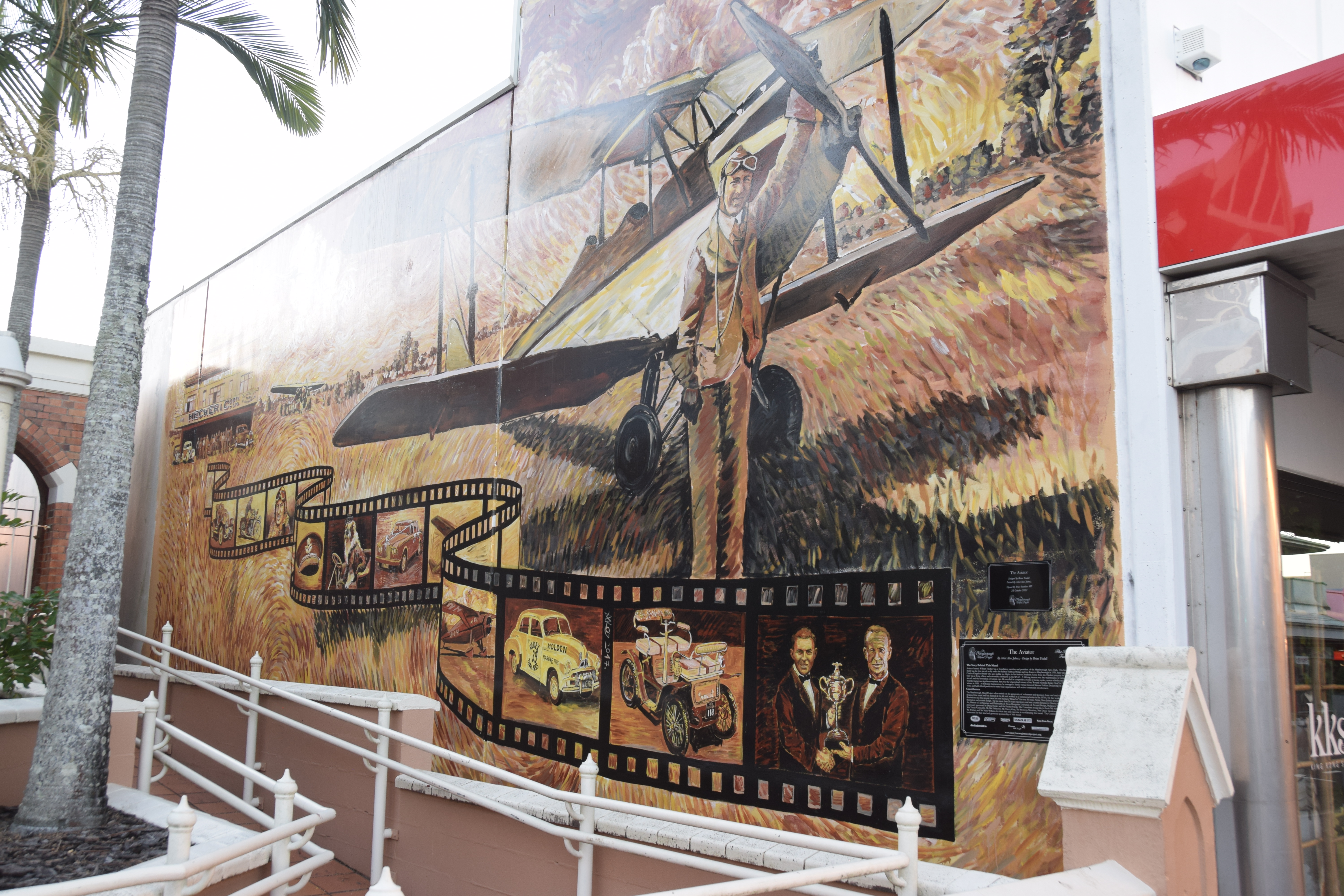
This colourful mural is of Samuel Hecker an aviator who was the first to fly (his Tiger Moth) under Sydney Harbour Bridge. It made me think of Denis Sargent (one of our core Rugby World Cup travellers) who recently died. His love of speed included flying a Tiger Moth and during his wake at Royal Canberra Golf Club one flew up the 18th fairway. Quite a way to go.
This last mural is a bit of fun rather than history. I suspect the person who put up the road sign did not join the dots.

A short journey away was an aboriginal sculpture garden. An Echidna can be seen in the background but I thought the pelican chairs were particularly imaginative.

Not that any of these stationary animals were of any interest to this Dusky Honeyeater.

Honey for us was covered in our next visit which was to the Bundaberg Rum Distillery. Unfortunately we had to lock all our metal goods away so photos were not allowed other than in the reception area. At least these enourmous vats could be snapped. There is a father and son team that make them over a 4 day period. The edge of the white oak timbers are slightly (but precisely) bevelled and then only held together by the metal hoops. Once filled, the moistened wood expands to prevent leaks. Some of the older barrels (not seen here) have small tarry spots where rum had initially seeped through.

One memorable point (which couldn’t be photographed) was a shed with a huge below ground concrete well some 20m by 50m and 4m deep. This held the molasses that is the by product of sugar manufacturing and is the key ingredient to rum. The well is slowly filled during harvesting so the distillery can produce year round. It is like a gooey quicksand – once in you are gone. I knew rum could be deadly but had no idea molasses had similar charateristics.

Of course there are a few varieties – I just had not appreciated how many….

Most cane sugar trains are pulled by small locomotives but not always.

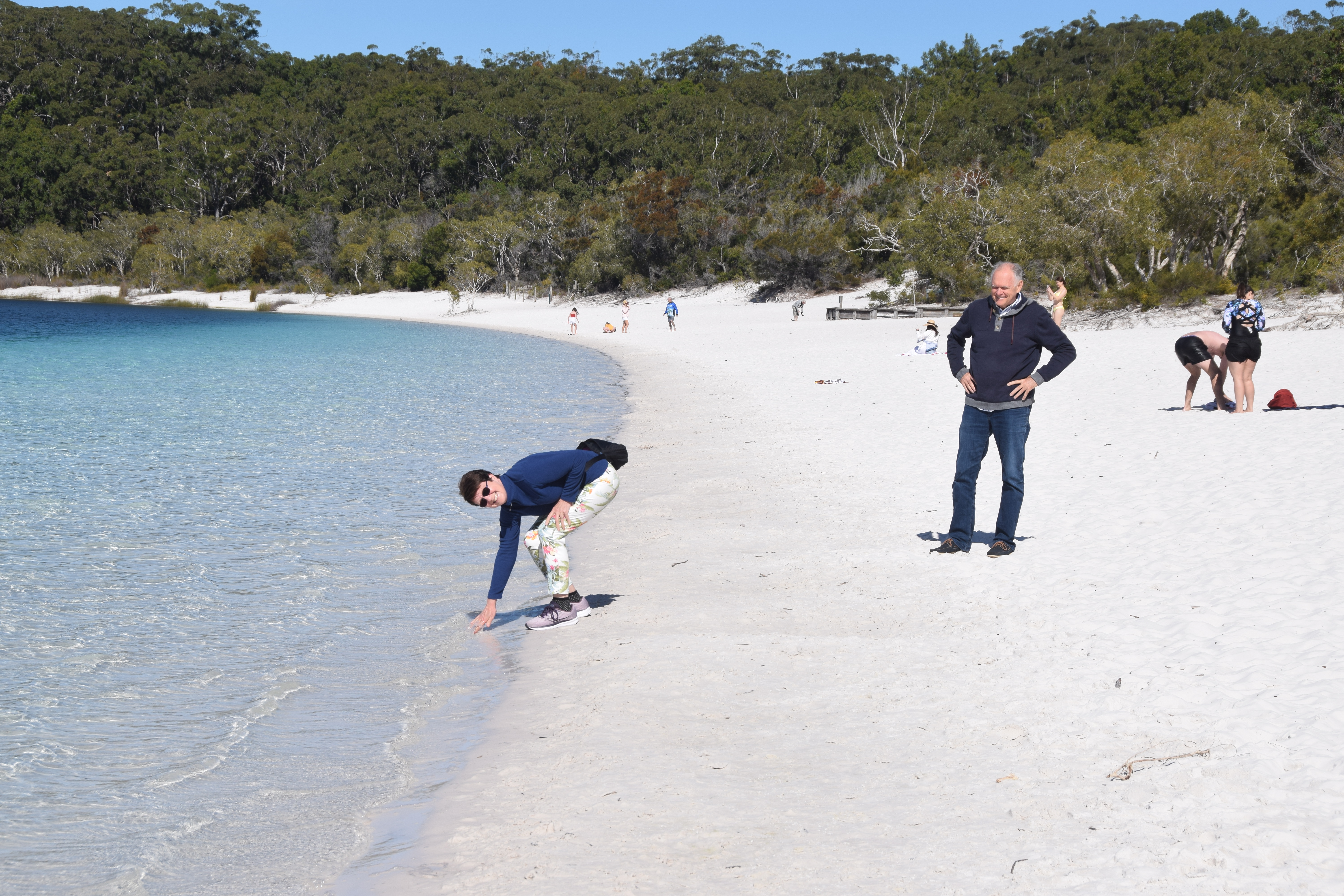
A key attraction of the area is a day trip to Fraser Island – the largest sand island in the world. We opted for a self drive tour. A very early start, 7:00 ferry and and somewhat too long safety briefing (we just wanted to get going) saw us on the track at about 9:00. First stop the stunningly beautiful Lake McKenzie. In the 80’s with young children we went for a swim. Happy to settle for a quick temperature check on this occasion.
Next stop Central Station! The largest population here are staghorn ferns. Their size is staggering. It's amazing how many are on one tree.

After slow going on the sometimes rough sand track we reached the East coast and smooth Seventy Five Mile beach. Here you can rip it up to 80 kph but need to be careful of the numerous river outlets.

The main attraction is the wreck of the SS Mehino which was being salvaged and towed to Japan. The tow rope broke in a storm so not much was salvaged!

A little further up are the Pinnacles. The afternoon light did not really help to pick up the varied coloured sands.


Winter is a relatively quiet affair. The beach was often deserted. No one in sight to the South.


And nothing to the North either – although this does prove I was there!

The rented Toyota cruiser had certainly paid its way with 400K kms on the clock.

There was an opportunity to have a quick flight. I had flown and landed on the beach in the 80s. You have to fly around and see where there is a sufficient length of beach between streams and then come around and land. On that occasion there was a stiff SE breeze and as we drew up to the resort we parked next to an old wrecked plane. My pilot said he thought he would meet his Waterloo here one day. Needless to say I drove to the island after that. It is a bit more professional now – they use cones to mark the strip!

On the way back we were escorted much of the way by this sea eagle.

A smooth part of the inland track with passing bay to the left. Those travelling uphill give way as it is easier to reverse in the sand downhill.

Some of the dunes go on for miles

Finally back at Kingfisher Bay resort we had a beer while waiting for the ferry and taking in the sunset.

The local sea eagle arrived on his lamp post perch for the night.

While the ferry took us back we marvelled at another wonderful sunset, reflected on a fabulous day and anticipated wine, dinner followed by an early night.

The “must do” trip in Hervey Bay is to go whale watching. When booking we carefully picked the calmest day of our stay so that Helen was happy to come aboard. The bay itself is huge. We travelled over an hour and were still an hour South of the Northern tip of the island. The island shelters these waters from the ocean and its swells.

And we were spoilt. Whales were everywhere. Here are a small selection of over a hundred photos. The humbacks came so close – they are very curious.

Travelling under the boat was also a bit of a lark – here you can see the tail of one on the sonar.
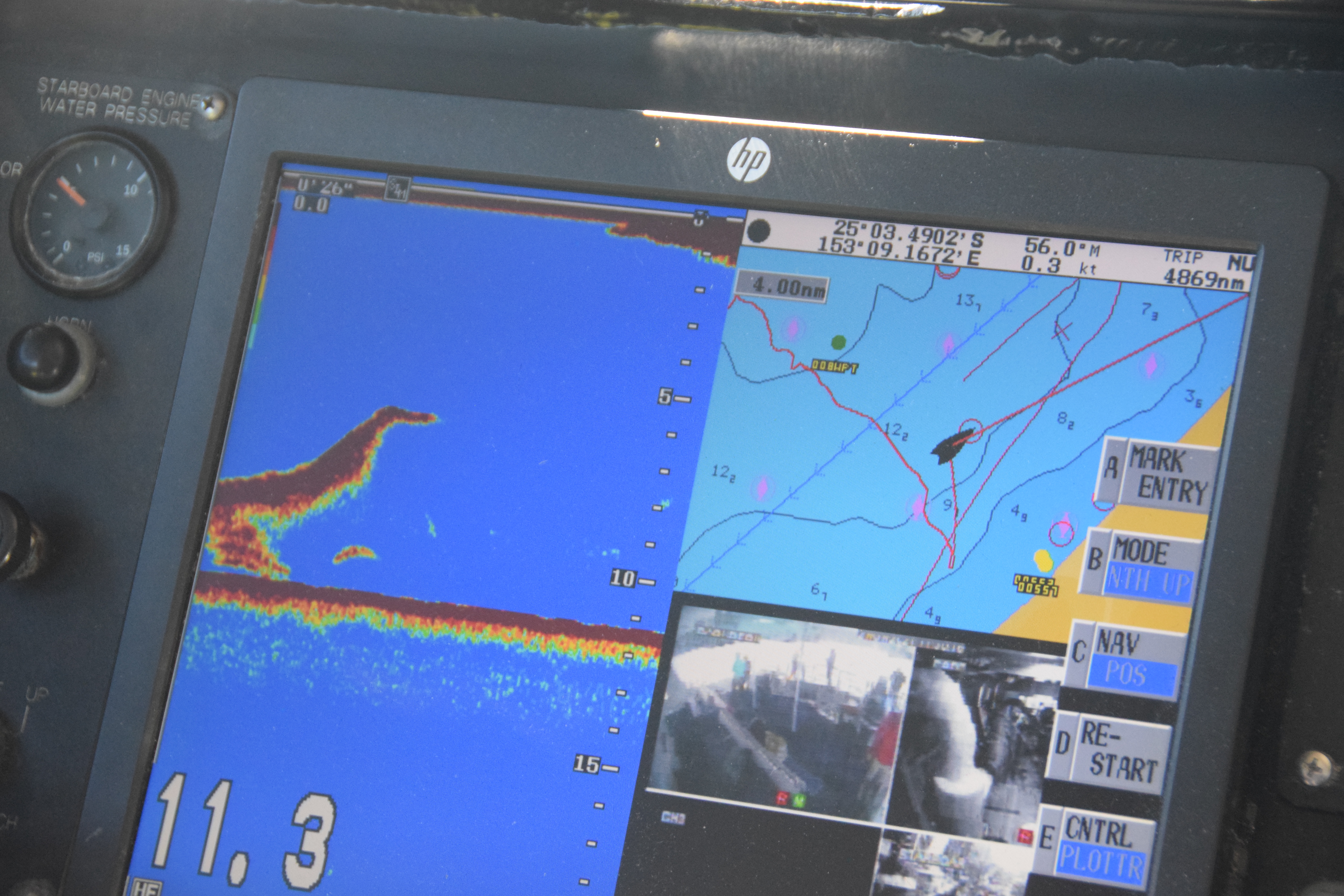
There are quite a few barnacles that enjoy a free ride. The Bay is used as a stopover to and from Antarctica. Many of the pods were of quite young whales.

It is the underside view of the tail that is key as it is unique and enables each whale to be identified.

How’s this for flexibility or is it a bit of a wave?

Or would you like to see my tummy….

Or maybe my pectoral fin (and tail).

If you are not paying attention 

Then giving the water a mighty slap will really make you jump.

A fantastic trip – it is easy to see how some have a season ticket to travel and see these wonderful creatures regularly.

We travelled back via some friends on the Sunshine coast and a couple of nights on Brisbane South bank with an evening at the jazz. Our final trip was to a quirky little village called Tyalgum. This is an eclectic mix of buildings catering for all tastes.

You can even have high tea at “Flutterbies” with quaint chinaware

and calm, antique surroundings. (There was even a grand piano in the corner behind me.)

Unfortunately, Covid once more reared its head (this time Brisbane CBD where we had just stayed) and the planned leisurely trip down the NSW coast had to be changed at the last minute to a 1100 kms one day dash for home so we could obey new “stay at home” orders under our own roof.

With the exception of the ending this was a great winter break. It was nice to encounter warmer climes and catch up with old friends. Here’s hoping that 2022 will allow us to get back to some Northern hemisphere travel.


Saturday, December 12, 2020

Norfolk Island - the Covid 19 antidote

Despite Covid 19, in mid November we found ourselves on a 2.5 hour overseas East traveling flight from Sydney International airport. We dutifully completed our quarantine forms, landed and passed through customs to find ourselves in --Australia, well Norfolk Island to be precise. For those scrambling for maps it is 767 kms from Noumea, about 1200 kms from the Northern tip of New Zealand and 1500 kms to Australia.

Helen had a momentus birthday this year and having spent decades pining to visit Norfolk Island it was an easy choice as a birthday surprise. It has a remarkable history, natural beauty and an abundance of birdlife but even knowing that we were taken aback at what else was on offer on this small island.

Interest in Norfolk Island started due to two natural resources – the Norfolk pine and flax. This is the lone pine on the Southern shore.

It is a very old tree having been recorded by Cook when he first called in on the 11th October 1774. He named the island after the Duchess of Norfolk who unbenown to him had died a couple of months earlier. Most of the other pines on the island are much straighter and Cook saw these as great for ship masts. Unfortunately, it was later appreciated that where the ring of branches meet, they go through to the center of the trunk and this forms a plane of weakness. However, the tree produces. . an excellent timber for all sorts of construction down to offcuts for roof shingles.

The second resource was flax the fiber for twine, rope, linen, sails etc. In England flax is soaked in water for a week or two to help rot the material around the fiber. (Here is an interesting video of the labour intensive process https //youtu.be/TFuj7sXVnIU ). However, that did not work in Norfolk and it took some time before it was realized that the solution was more hard work – scraping.

The original town (inevitably named Kingston) started with the first penal settlement in 1788. The island also helped supply resources and food for Sydney and of course to keep the French from expanding their empire. There is one street named “Quality Row” with some beautiful stone buildings. (No 1 at the Eastern end near the cemetery is now the golf club house.) Pretty as a picture!

In 1814 (by which time many freemen had done very well) the island was largely abandoned because of its distance from Australia. Ten years later in 1824 it was decided to re-open the island (second settlement) for the worst convicts. This resulted. In the cruellest conditions imaginable with convicts sentenced to 7, 14 or 21 years. One minor example-they were fed salted pork despite being fresh pork on the island. This was so they would not enjoy the food and also quench their thirst by having to drink poor quality water.

Some of the Governors could only be described as sadistic. We had an entertaining dinner hosted by three governors who described some history, joined us to eat and go into further detail (including their real lives). This one with Helen was John Price who was particularly cruel. The actor had a wonderfully gruff voice so was well suited to his role. 

The prison was large and took many years for the convicts to build. The stone was cut from the nearby reef and Nepean island. Much of the interior was destroyed by the Pitcairns who occupied the island from 1855 when Queen Victoria decided that the prison should be relocated to Tasmania.

Many died on the island (both convicts and warders). Some of the headstones are quite harrowing even if the type setter did not have much of a future!

To the South is Phillipe island which was largely reserved as a play area for the warders. Rabbits were introduced so they could hunt. What a disaster. In 1974 the whole island was completely denuded with little topsoil exposing the underlying red weather rock. Following an intense regime killing off the rabbits the island is now slowly coming back to life with more areas now green than red but there is still some way to go.

The memorial where Helen is seated uses bricks from Captain Arthur Phillip's house at Vernall's Farm, Lyndhurst (near Southampton) and commemorates HMS Sirius which was wrecked off Norfolk on 18 March 1790.

Here is the first arched bridge ever built in Australia – some of the warders and convicts were quite skilled.

The third part of the story also stems from UK but from a quite different direction! Mutiny on the Bounty is a story many know. In short Fletcher Christian and some men on the Bounty had developed relationships in Tahiti and when the Bounty recommenced its journey they decided a few weeks out to mutiny and set Captain Lieutenant William Bligh and 18 loyalists adrift in a long boat on 28 th April 1789. Bligh took some 7 weeks to arrive in Timor – remarkable seamanship and resilience.

Meanwhile Christian returned to Tahiti, collected the woman and some men and set sale for… .. anywhere they could not be found. Eventually they came across a small island called Pitcairn. Bounty scuppered, Christian dead, a couple of generations and they had outgrown the small island. When Queen Victoria heard of the self governing success of the settlement, the need to abandon Norfolk so as to focus on Australia and the ongoing challenge of keeping the French at bay she was happy to offer Norfolk to the Pitcairns.

The ability to get on with people is still abundantly clear today. Nothing is too much trouble, every driver waves to oncoming drivers – I suspect it is such a habit they do it an night – its just that no one can see! They are Royalists to the hilt and have a real leaning towards Britain. However, in 2016 they gave up self-governance and are now under NSW state's umbrella for schools and health but vote for the Federal government through Bean which is one of the Canberra electorates.

That's the last of the history!

The island has perfect weather 15 – 24°C all year round with gentle breezes. I suspect they may have some bigger winds on occasions but the air is wonderfully clear. A luxurious climate needs luxurious accommodation. G & T in the spa before dinner was essential. We stayed in the Tim Sheds which comprises 3 No 5 star units. One of our neighbors had had one night in Paradise and advised Paradise was not paradise and Tin sheds was not tin sheds!

A quick trip across the island of almost 10 minutes to enjoy the setting sun with wine, cheese and biscuits. What a tough life.

Not a bad view either.

Even the following day in full sun it is still spectacular. Anyone for a cool dip? Followed of course by a much more warming climb back up!

It looks peaceful but Terns made sure it was not too quiet.

This retired boat is similar to those still operating today. Getting goods onto the island is a real challenge. The jetty is small and does not quite reach the start of the reef. It can only accommodate boats of this size so when shipping a bus, two of them are tied together and the bus straddles them. It is lifted off the ship and onto the jetty by cranes. Pretty risky stuff particularly when there is a bit of swell!

Naturally framed shots are everywhere.

What was a surprise were a line of Moreton Bay Fig trees to the South of the airport. Their huge buttress like roots dwarf passers by and slowly wrap around pines so they cannot escape.

Not to be outdone there are one or two huge Banyon trees. The canopy is supported by many aerial prop roots. This one is about 30 metres diameter at ground level.

Mind you the pines help host other vegetation such as this “old man's beard” – although I prefer the alternative name of Spanish moss.

Cows abound and with lush grass they are in great condition. Car hire is a must because of the ups and downs but with 40 kph in town, 50 kph out of town and cows turning up anywhere travel is a very relaxed affair. Even the 40 kms / day allowance is not an issue as North to South or East to West are both only 10 minutes.

The Queen Victoria botanic gardens were ideally located next to one of our lunch stops and helped with a little digestive exercise.

The sculptures using driftwood of a dragon above and deers below were very imaginative.

Away from the town where it was quieter, we were followed by a natural choir. The lead chorister was the blackbird with backing from birds too many to list. Nonetheless, there were some worth a mention. Although the White Faced Heron is far from a rare bird it was a little unusual to see one down by the sea rather than on an inland waterway.

Although numerous it was hard to get close to these California Quails. 

By contrast the Kingfisher was a little less shy although finding a pair was a lucky and unexpected experience.

Much of the North of the island is national park and although far from rare it was a delight to see this Gray Fantail demonstrating why he is so named.

The Tern is a lazy parent. No nest for these birds – just perch the egg on a bough and hope for the best. Mind you some obviously survive as they are numerous.

Lazy home builders or not youngsters still need feeding.

Its close relative the Sooty Tern is also quite abundant and a bit more attractive with its contrasting colors.

The Red-tailed Tropic bird is also easy to spot.

What was magical was to get a close up of these Masked Booby's. There were three couples on this headland although the other two comprised a parent and youngster.

What was a surprise was seeing this Great frigatebird – they are majestic fliers.

And last and far from least is the green parrot. This bird nearly went extinct and was down to 20 birds. It is now up to 200. When we heard these numbers we did not expect to see one but were wondering through the botanic gardens and saw this one flit into the tree and start eating. He was like a teenager – nothing was going to get in the way of him and a feed.

We proceeded round the gardens and half an hour later there he was again, obviously full and just wanting his picture taken. Humans have helped with rearing so the parrots have no fear of our proximity.

So just to be clear – this is 1 of 200 birds of its type in the world !!!!

That is the perfect end to a perfect week. Would we go back – absolutely there is more to see and do (golf and diving were not touched!). A wonderful relaxed week which was very reasonable compensation for Covid preventing this year's Northern hemisphere trip ..